Headlines


Washington


CU System


Market


Products & Services


Consumer


Print Today’s News


Photo Gallery


Videos


Monthly Top 10


Archive


Headlines via Email

Enter your email address:
text or HTML

RSS Feed Newsnow Headlines via RSS
What is RSS?


Contact News Now

News Now Archive

Filed on March 6, 2008, published the first business day after.

CU reg relief issues get full hearing in House

Click for slide show (CLICK TO VIEW PHOTO ESSAY) "By law--not regulation, as for other insured depositories--credit unions must maintain a 7% net worth or leverage ratio in order to be considered ‘well capitalized,'" Dorety told the committee. "In comparison, the current leverage ratio for banks to be well capitalized is only 5%. This capital requirement for credit unions is inefficient in that it unnecessarily retards member service and growth, and it does not appropriately account for risk of a credit union's assets." The CUNA chairman said Congress should consider the removal of all of the prompt corrective action (PCA) stipulations from the statute and "leave it to regulatory determination, similar to the system under which the banking industry operates." (Photo provided by CUNA)
WASHINGTON (3/7/08)—It could be argued that the star of Thursday's congressional hearing on credit union regulatory relief was the important role credit unions are playing to help communities through the "subprime mortgage meltdown," even though they were not part of the problem.

That role was highlighted by a number of the members of the House Financial Services Committee—including Chairman Barney Frank (D-Mass.)—during that panel's hearing entitled "The Need for Credit Union Regulatory Relief and Improvement."

Frank, in his remarks opening the hearing, said he hoped his colleagues would follow their debate about the regulatory relief issues with some definite action for credit unions. He thanked Rep. Paul Kanjorski (D-Pa.), who heads the panel's subcommittee on capital markets, for his role in spearheading credit union regulatory relief efforts.

Kanjorski, along with Rep. Ed Royce (R-Calif.), is author of the Credit Union Regulatory Improvements Act (CURIA, H.R. 1537), which has 145 backers in the House, and the very recently introduced Credit Union Regulatory Relief Act (CURRA, H.R. 5519).

Kanjorski chaired the remainder of the hearing at the chairman's request.

National Credit Union Administration (NCUA) Chairman JoAnn Johnson was the first of four credit union movement witnesses to testify. She keyed primarily into two major issues; reforming prompt corrective action (PCA) rules and allowing all credit union charter types to offer services to underserved areas.

Johnson said the legislation being discussed by the committee would allow Congress to grant greater flexibility to credit unions serving consumers and to strengthen the NCUA's ability to maximize the safe and sound operation of federally chartered credit unions.

Honing in on PCA reform as her top priority as a regulator and a "necessary tool," Johnson said a risk-based capital system, more aligned with that of the banking and thrift industries, would improve the current credit union "regulatory regime" and "put more money in the members' hands." CURIA proposes such a system.

She added that it would: promote more active management of risk by credit unions in relation to capital levels; enable credit unions to better relate their capital to risk assessment; and strengthen NCUA oversight by adding tools to identify each credit union's risk profile based on their activities.

Tom Dorety, CEO of Suncoast Schools FCU, Tampa, Fla., testified on behalf of the Credit Union National Association (CUNA) as its new chairman.

He told the House committee members he finds it truly ironic that as the economy experiences a credit crunch in many sectors and credit unions stand "ready, willing and able to help alleviate the problem and promote economic growth," credit union efforts to do so are inhibited by "outmoded laws that protect the narrow self interest of bankers."

He urged Congress to support legislation that would improve a current 12.25%-of-assets cap on member business lending (MBL) by raising it to 20% of assets.

"There is no economic rationale for this cap," Dorety said, noting credit unions have been providing such loans safely for more than 100 years. Also, CUNA urged lawmakers to exempt from the cap MBLs made in underserved areas.

The CUNA witness also backed the NCUA's plan for a risk-based capital system and the statutory clarification that all federal credit unions may apply to NCUA to add underserved areas to their fields of membership.

"We are forced to ask Congress for this provision because the American Bankers Association (ABA) sued NCUA in 2005 for authorizing single-sponsor and community-chartered credit unions to add underserved areas to their field of membership."

In a juxtaposition of banker actions that Rep. Brad Sherman (D-Calif.) said defined the term "chutzpah," Dorety reminded the committee that in November 2005 the ABA complained before the House Ways and Means Committee that credit unions do not do enough to serve people of modest means. Then, within days, it took credit unions to court to prevent them from doing so.

Also testifying as part of the credit union panel at the hearing were the National Association of State CU Supervisors, the National Association of Federal Credit Unions and two banking industry representatives.

On a separate bankers' panel, the ABA and Independent Community Bankers of America were represented.

In a related story, earlier this week Sen. Mary Landrieu (D-La.) told the more than 4,500 attendees of CUNA's Governmental Affairs Conference here that she soon will introduce a Senate version of the CURIA bill. Sen. Joe Lieberman (I-Conn.), also addressing the GAC, vowed to be an original co-sponsor of the measure.


Lieberman: CUs represent classic American ‘ideal’

WASHINGTON (3/7/08)—Sen. Joe Lieberman (I-Conn.) reiterated his pledge to credit
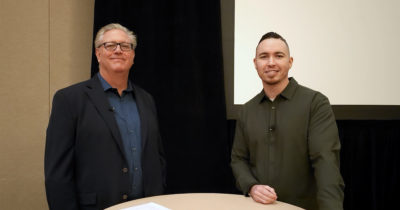
Click to view larger image U.S. Sen. Joe Lieberman (I-Conn.), left, and CUNA President/CEO Dan Mica backstage before Lieberman addressed Thursday's GAC closing general session. (Photo provided by Robert Knudsen)
unions that he would fight any attempt to take away the tax-exempt status of credit unions and said credit unions' cooperative model represents a classic American ideal of "people getting together."

Addressing the closing session of the Credit Union National Association's Governmental Affairs Conference, Lieberman said that America is a "remarkably diverse" country and that credit unions represent the "length, the depth and the breadth of our country."

"Unity, confidence, optimism—working for the common purpose—is what you represent."

Lieberman said he recognized the importance of the Credit Union Regulatory Improvements Act to credit unions and pledged to be an original co-sponsor of a bill that Sen. Mary Landrieu (D-La.) plans to introduce in the Senate.


Royce: CUNA one of 'most effective organizations'

WASHINGTON (3/7/08)—Just a day after representatives from at least 18 state credit union leagues hiked Capitol Hill to share the credit union message, Rep. Ed Royce (R-Calif.) called the Credit Union National Association (CUNA) one of the "most effective organizations" he's ever seen on the hill.

Royce, who introduced the Credit Union Regulatory Relief Act (CURRA, H.R. 5519) with Rep. Paul Kanjorski (D-Pa.) Monday, was one of three members of Congress who spoke during yesterday's CUNA Governmental Affairs Conference (GAC) closing session. Royce reminded credit unions of the importance of the Credit Union Regulatory Improvements Act (CURIA), saying he intends to get that bill passed.

Royce pledged to his credit union audience that "we're going to continue efforts until the job is done." He added, "I want to remind people that we don't want the government to be an obstacle of economic growth."

The impact of credit unions is great—they pool resources that create liquidity, Royce said, noting that he has seen how credit unions in third-world countries have helped build a stable and safe financial system.


Senate Finance chair recognizes CU efforts

WASHINGTON (3/7/08)--Credit unions know that there's no place like home, and they also know that without homes there is no community—which is why they work to keep members in their homes, according to Sen. Max Baucus (D-Mont.), another Governmental Affairs Conference (GAC) closing session speaker.

Baucus touched on the problems triggered by the subprime loan debacle, highlighting credit unions' community investment. In addition to creating affordable loans, credit unions help by providing financial education and free income tax assistance, Baucus said.

"Credit unions are helping the next generation be wise with money," he said.

The senator encouraged credit unions to take advantage of the opportunities and continue helping. Credit unions have played a large role in Montana and nationwide by making loans that are not predatory, he added.

"Credit unions are the foundation of the community," he said. "They can demonstrate the benefits of cooperative lending."

The GAC was presented in Washington by the Credit Union National Association this week.


Inside Washington

  • WASHINGTON (3/7/08)—House Financial Services Committee Chairman Barney Frank (D-Mass.) is planning to introduce a second economic stimulus package that would attempt to steady the troubled credit and housing markets. One challenge posed by the bill would be whether or not the lending industry is willing to cooperate (American Banker March 6). When questioned if he was planning to ask lenders to take a "haircut" on mortgages in trouble, Frank replied that a lobotomy was in order instead. Under Frank's proposal, the government could buy mortgages written down by lenders, which appears to contradict any prior notions of a bailout. President George W. Bush has already stated his opposition to a lender bailout ...

  • WASHINGTON (3/7/08)—Federal Deposit Insurance Corp. Chairman Sheila Bair is urging Congress to move forward on legislation that would forbid commercial ownership of industrial loan companies (ILCs). A moratorium on ILCs expired in January, leaving the agency without guidelines on how to tackle pending ILC applications. A bill that would restrict commercial ILC ownership is currently stalled in the Senate ...

  • WASHINGTON (3/7/08)—The Federal Home Loan Bank (FHLB) of Chicago values itself at $800 million, and if the FHLB Dallas accepts that, a merger proposal could be created within a couple of weeks. The merger must be approved by the Federal Housing Finance Board, and FHLB Chicago's value could change, depending on the markets. A spokesman for Chicago FHLB said terms still need to be finalized ...

  • WASHINGTON (3/7/08)—The Office of Federal Housing Enterprise Oversight (OFHEO) yesterday released the maximum conforming loan limits that will be in effect throughout 2008 as a result of the Economic Stimulus Act of 2008. The maximum for temporary jumbo conforming loan limits, which apply to loans originated in the period between July 1, 2007 and Dec. 31, 2008, are as high as $729,750 for one-unit homes in the U.S. ...


NCUA is offering Cal State 9 for bidding

CONCORD, Calif. (3/7/08)--The National Credit Union Administration (NCUA), the conservator for Cal State 9 CU, is offering the credit union up for bid to be combined with another credit union.

The $339 million asset, Concord, Calif.-based credit union was placed under the management of the NCUA in conservatorship in November 2007.

"This week, NCUA representatives came to a decision to pursue the combination of Cal State 9 with another credit union," wrote Melinda Love, NCUA Region V director, in a Feb. 29 letter to Cal State 9 members.

"This transaction, known as a ‘purchase and assumption,' represents the most financially sound decision and is in the best interest of Cal State 9's membership. It will ensure that you continue to have high-quality financial services into the future without interruption," she added.

All prospective purchase-and-assumption credit unions have sound financial management and are federally insured by the National Credit Union Share Insurance Fund (NCUSIF), Love noted. She reminded members that all their deposits are safe and secure--insured by NCUSIF.

The process is expected to be finalized in early summer 2008, Love wrote.

Cal Sate 9 was unavailable for comment.

Almost 98% of delinquent loans that prompted regulators to put Cal State 9 CU into conservatorship were real estate loans that were in arrears (News Now Nov. 6).

In June, Cal State 9 reported delinquent real estate loans totaling $25.8 million, more than five times the $4.6 million it reported the year before (The Oakland Tribune Nov. 3).

In first-quarter 2007, Cal State 9 earned $1.6 million; at the end of second quarter--about the time the subprime mortgage market began to realize it was in a crisis--the credit union had lost $9.1 million, said the newspaper, which examined the credit union's public filings with NCUA.

Cal State 9 CU lost $45.9 million during the first nine months of 2007 with the majority of the losses occurring in mortgage loans, many with adjustable rates (News Now Nov. 9).


Massachusetts CU assets rise 4.1%

MARLBOROUGH, Mass. (3/7/08)--Total assets for credit unions headquartered in Massachusetts tallied $24.6 billion during 2007, up 4.1% over year-end 2006.

Credit union assets in the state constitute 9.4% of all financial institution assets in the state, the Massachusetts Credit Union League reported on its website.

Credit union deposits increased by 1.87%, closing 2007 at $20.1 billion. Credit unions hold a 10% share of the market for insured deposits in Massachusetts. Loans rose 4.84%, finishing the year at $18.2 billion.

There were 228 credit unions headquartered in Massachusetts at the end of 2007, with 58% holding federal charters and 42% state charters.

Credit unions serve roughly 2.44 million citizens of Massachusetts or 38.2% of the population--a 1.67% increase over year-end 2006.


New NCUF chairman supports DE expansion

WASHINGTON (3/7/08)--Allan Kemp McMorris, the new National Credit Union Foundation (NCUF) chairman, has pledged more financial and human resources to expand the Credit Union Development Education (DE) program in the U.S. and worldwide.

New National Credit Union Foundation Chairman Allan Kemp McMorris was cheered on by more than 75 Credit Union Development Educators at the Credit Union National Association's Governmental Affairs Conference in Washington, D.C., this week. (Photo provided by the National Credit Union Foundation)
"Credit union philosophy is our most important asset," McMorris said in his first address to Credit Union Development Educators (CUDEs) during the Credit Union National Association's Governmental Affairs Conference in Washington, D.C.

"I not only pledge the foundation's support, I pledge my personal support. I promise you I will become a CUDE before the end of my term as foundation chair," he added.

DE Program Director Tom Decker highlighted several new initiatives planned for this year:

  • 2008 DE Workshop. All DE training alumni are invited to a new learning event to be held May 21-24 in Seattle. The workshop will feature tours of the Biz Kid$ set while an episode is being filmed for PBS; tours of IslandWood, where a sustainable environmental is the classroom; and a course on micro-finance from international facilitator Carol Schillios;

  • International DE Council. DE program leaders from Australia, Canada, the Philippines, the United Kingdom and the U.S. plan to facilitate curriculum enhancements and training exchanges; and

  • International Development Certification. NCUF and the World Council of Credit Unions (WOCCU) are exploring ideas to recognize leaders who graduate both from DE training and from international programs offered by WOCCU.


Washington State announces Top 10 investment scams

OLYMPIA, Wash. (3/7/08)--Credit unions can help alert members to the top investment scams circulating in several states.

The Washington State Department of Financial Institutions (DFI) Securities Division last week announced the Top 10 investment scams in that state. Most are perennial favorites of scam artists who dress them up with the latest investment angle or news, said DFI, the state credit union regulator.

Credit unions can tell their members to understand what they are investing in. "Investors can protect themselves, and their financial futures, by investing a little more time before investing their money," said DFI Director Scott Jarvis, who noted that "if it sounds too good to be true, it probably is."

The top scams in Washington State were:

  1. Ponzi schemes. A business supposedly earns money to pay high returns to investors. However, it actually earns little or no funds; instead, it relies on new investors to pay the early depositors' "profits." The scheme collapses when new investor money runs dry.

  2. Fraud against seniors. Older investors with money are targeted by complex investment scams involving unregistered securities, promissory notes, charitable gift annuities, viatical settlements and Ponzi schemes promising inflated returns.

  3. Promissory notes. Short-term debt instruments are issued by little-known or nonexistent companies promising high returns (such as 15% monthly) with little or no risk. When interest rates are low, these notes lure investors hoping for higher, fixed returns--which never arrive.

  4. Unscrupulous brokers. While stockbrokers' assistance is often helpful for many investors, investors should educate themselves so they can detect any problems that signal an unscrupulous operation.

  5. Affinity fraud. This fraud preys on human nature, where people trust people like themselves. Scammers use religious or ethnic identity to gain the victim's trust, and no group is immune from this type of fraud.

  6. Unlicensed securities sellers. High-risk investments--such as promissory notes, oil and gas deals, gold or mining stock and viatical settlements--may be sold by unlicensed individuals. Scam artists entice independent sales agents into selling investments about which they know little.

  7. Prime bank schemes. Con artists promise investors triple-digit returns through access to portfolios of elite or "prime" banks. Today, they it is common to avoid the term "prime bank" and underplay the banks' role by referring to "risk free guaranteed high yield instruments" or something similar. They often reference "treasury securities," "letters of credit," or similar methods. Scammers also push "tax free" money by using "offshore accounts" to entice investors.

  8. Internet fraud. Spam e-mails, chat rooms and online investment "newsletters" often promote stocks with hype and false information, offering a "quick profit" to lure investors who buy and drive up the price of the stock, which the promoter then sells. Investors should ignore e-mail offers, especially those from individuals needing "help" to deposit large sums.

  9. Free lunches and dinners. A yearlong study of free-meal investment seminars by state securities regulators across the nation found abusive tactics at "educational" free lunch and dinner seminars. All were actually sales presentations, and 13% were fraudulent.

  10. Telemarketing fraud. Boiler rooms and high-pressure telephone sales operations peddle illegal or fraudulent investment products nationwide.

Each year, Washington residents alone lose between $50 million and $100 million in such scams. The amounts reported may be only a small fraction of actual losses, DFI said.


Company makes takeover bid on Canadian CU

EDMONTON, Alberta (3/7/08)--An insurance company based in High River, Alberta, has made a surprise takeover bid for Community Savings and CU, an Edmonton-based credit union whose members will meet March 18 to vote on a merger with two other Alberta credit unions.

Western Financial Group President/CEO Scott Tannas said the company asked that the offer be included on the agenda at the credit union's membership meeting (Canada.com and Edmonton Journal March 6).

The company is offering an unspecified "cash windfall" for members, job security for employees and maintenance of the products, prices, service levels and branches that exist today, Tannas said.

The credit union had proposed merging with Servus Credit and Common Wealth CUs. The three--among the four largest credit unions in Alberta--announced Feb. 8 they were considering a merger because they faced competition from British Columbia-based credit union, Vancouver City Savings, Canada's largest credit union.

Tannas said the credit union and his organization--which provides insurance, financial services and banking services to more than 80 communities in Western Canada--have similarities.

"We are in many of the same towns and cities, we have the same community-based values and culture, and we estimate that 20% of Community Savings members are already insurance customers of Western Financial Group," he said.


CU System briefs

  • KNOXVILLE, Tenn. (3/7/08)--A Knoxville man was charged with second-degree murder in the death of his wife, who was run over with a car Wednesday at an ATM outside the East Knoxville branch of ORNL FCU. Carlos Radal Cornwell, 35, was charged after Leoned Boulanger Cornwell, 42, was found dead in the credit union's parking lot. Police said the couple were in a car at the ATM and argued. Leoned Cornwell exited the car, and the car allegedly backed over her (The Knoxville News Sentinel March 6) ...

  • HARRISBURG, Pa. (3/7/08)--Two staffers of Franklin Mint FCU, Broomall, Pa., were guests last week on Philadelphia's NBC 10 program, "All That and More," according to the Pennsylvania Credit Union Association (Life is a Highway March 5). Rick Durante, vice president of education, and Kelly Lynn, district manager of the credit union answered money management questions from fourth- and fifth-grade students. The program focused on youth financial education during Philly Saves Week ...

  • PROVO, Utah (3/7/08)--Two men face charges of armed robbery after their arrest Tuesday 90 minutes after a robbery was reported by Utah First CU. Christopher Mollner and Ira Wakefield are being held on robbery charges. Police said Mollner allegedly entered the credit union with a pistol, handed a teller a note demanding money, and fled with cash in a white van. Ninety minutes later Utah Highway Patrol trooper pulled over the van, where he found the men, cash covered in red dye and a BB gun. Mollner's 11-month daughter, who was in the van, was taken into protective custody (Daily Herald ksl.com and kutv.com March 5) ...

  • WASHINGTON (3/7/08)--Norman Mann, former CEO of Department of Commerce FCU, Washington, D.C., died Feb. 26, after suffering a stroke the day before, said the Maryland and District of Columbia Credit Union Association (FOCUS Newsletter March 3). He served the credit union for several decades. Funeral services took place March 1 in Bowie, Md. Contributions may be made to the American Heart Association, Memorials and Tributes Processing Center, P.O. Box 5216, Glen Allen, Va. 23058-5216 ...

  • HOUSTON (3/7/08)--Carol J. Letz, chairman of Houston Highway CU, died Monday after an extended illness, according to the Texas Credit Union League (LoneStar Leaguer March 6). Letz served the credit union in several capacities for more than 35 years, the past six years as chairman. She also was a member of the State Employees CU Association since 1973 and served as president for several years. Funeral services will be at 1 p.m. today at Southpark Funeral Home ...


Market News

MADISON, Wis. (3/7/08)

  • Home foreclosures jumped to a record high during the fourth quarter of 2007, according to the Mortgage Bankers Association (MBA). The rate of loans entering the foreclosure process was 0.83% seasonally adjusted--topping the previous record high of 0.78% set in the third quarter. The fourth-quarter rate was 29 basis points higher than a year earlier. The percentage of loans in the foreclosure process was 2.04% of all loans outstanding at the end of the fourth quarter--up 35 basis points form the previous quarter and 85 basis points from a year earlier. "Declining home prices are clearly the driving factor behind foreclosures, but the reasons and magnitude of the declines differ from state to state," said MBA Chief Economist Doug Duncan. He cited job losses in Ohio and Michigan and overbuilding in California, Florida, Nevada, and Arizona (mbaa.org and Associated Press via The New York Times March 6) ...

  • Mortgage delinquency rates surged during the fourth quarter of last year, according to the Mortgage Bankers Association (MBA) report. The delinquency rate--30 days or more overdue--stood at 5.82%, up 23 basis points form 5.59% in the third quarter and the highest rate since 1985. The rate was 87 basis points higher than a year ago. Subprime borrowers were the hardest hit. The delinquency rate for subprime adjustable-rate mortgages jumped to a record-high 20.02%--from the previous record high of 18.81% set in the third quarter. MBA Chief Economist Doug Duncan predicts that both delinquencies and foreclosures will continue to increase over "the next couple of quarters." However, he said there is a bright spot for many homeowners. "Of significance ... is that the rate reset issue on adjustable rate mortgages is becoming less of an issue. The 6-month LIBOR rate, the index rate used for many subprime ARMs, has come down around 2.5 percentage points since last September, greatly reducing the payment shock on many ARM resets." (mbaa.org and Associated Press via The New York Times March 6) ...

  • Pending sales of previously-owned homes were unchanged in January, the National Association of Realtors (NAR) reported Thursday. NAR's Pending Home Sales Index, based on contracts signed in January, remained at 85.9. The steady reading was welcome news to analysts, who had anticipated a drop in the index. However, sales were down 19.6% from a year earlier. NAR predicts that existing-home sales will hold steady through late spring, then gradually recover during the second half of the year, as mortgages in high-costs areas become more available. "The higher loan limits for both FHA and conventional loans will increase consumer choice and provide greater access to lower interest rate mortgages in high-cost regions," said NAR Chief Economist Lawrence Yun. "Therefore, a notable rise in home sales can be anticipated in the second half of the year." (realtor.org and Reuters via The New York Times March 6) ...

  • Weak economic news prompted a decline in mortgage rates this week, according to Freddie Mac. The average 30-year, fixed-rate mortgage (FRM) fell 21 basis points to 6.03%, while the 15-year FRM dropped 25 basis points to 5.47%, and the one-year, adjustable-rate mortgage (ARM) declined 17 basis points to 4.94%. "Weak economic reports that indicated declines in the job market, slowing in manufacturing and low consumer confidence drove bond yields lower this week and mortgage rates followed," said Freddie Mac Vice President and Chief Economist Frank Nothaft. "Interest rates for 30-year FRMs are now at the same levels as they were two weeks ago, erasing last week's upward jump," added Nothaft. A year ago, the 30-year FRM stood at 6.14%, while the 15-year FRM was at 5.86%, and the one-year ARM averaged 5.47% (CNNMoney.com and MarketWatch March 6). For CUNA's Daily Financial Rates, use the link. ...

  • While unemployment claims declined last week, the number of people remaining on jobless aid rose to the highest level in almost two-and-a-half years. First-time claims for unemployment benefits fell by 24,000 during the week ending March 1 to 351,000, the Labor Department reported Thursday. Continuing claims--the number of people still on the benefit rolls after an initial week of aid--increased by 29,000 during the week ended Feb. 23 to 2.831 million--the highest level since September 2005 in the aftermath of Hurricane Katrina. Analysts expect claims to continue to rise in the months ahead as weakness in the housing market spills over into other sectors of the economy (Reuters via Yahoo! News and MarketWatch March 6) ...


News of the Competition

MADISON, Wis. (3/7/08)

  • Merrill Lynch announced Wednesday that it plans to close its First Franklin subprime-mortgage loan unit. Merrill said it is exiting the subprime-lending business because of the deteriorating market. The company plans to eliminate 650 jobs at the unit. Merrill said it will attempt to sell First Franklin unit Home Loan Services, which handles billing and collections. Merrill purchased First Franklin from National City Corp in December 2006 at the peak of the mortgage boom. Merrill took more than $14 billion in writedowns during the fourth quarter as the value of bonds and debt backed by mortgages plunged. Other investment banks including Bear Stearns, Lehman Brothers Holdings and Morgan Stanley also have cut mortgage-related jobs since the credit crisis began in August (Reuters and Associated Press via Yahoo! News March 6) ...

  • Ambac Financial Group said Wednesday that it plans to sell $1.5 billion in stock to help protect its "AAA" credit rating and avoid splitting the company in two. The ratings agencies are reviewing bond insurers because they're worried they won't have enough funds to meet a surge in claims as the mortgage market continues to falter. Shares of Ambac dropped Thursday morning after Goldman Sachs Analyst James Fotheringham said the company needs to raise a much-larger $2.5 billion to retain its credit rating. "Ambac's highly-anticipated capital plan is not enough," said Fotheringham (Associated Press via CNNMoney.com March 6) ...

  • Standard & Poor's again lowered its ratings for Washington Mutual, the nation's largest savings and loan, and said it may cut the firm's ratings further as mortgage-market weakness continues. S&P lowered its rating for WaMu by one notch to "BBB." "We now believe that the severity of losses on all residential mortgages will be higher than we had thought and that the weak housing market will now be a longer cycle," said S&P. The ratings agency predicted that loan losses and delinquencies will continue to climb. Rating downgrades have boosted the cost to insure WaMu's debt--from 407 basis points at the beginning of the year to 560 basis points, according to Markit Intraday (Reuters via CNNMoney.com March 6) ...

  • Mortgage demand remained weak during the past six weeks, according to the Federal Reserve's latest Beige Book report. However, the Fed noted that refinancings surged in the San Francisco, St. Louis, New York, Richmond, Atlanta, Cleveland and Chicago districts. In another bright spot, the Chicago and Cleveland districts reported rising business-loan demand. The central bank said some districts reported flat or falling demand for other loan types, and some reported rising delinquencies for several types of loans (American Banker March 6) ...

  • The Securities and Exchange Commission has proposed changes in regulations that would let exchange-traded funds (ETFs) be launched quickly without review by federal regulators (Dow Jones Newswires and sec.gov March 6). The proposal also would let mutual funds invest in ETFs more easily. The agency said the new rules would save sponsors the time and expense of obtaining approval, thus "eliminating a barrier of entry for new participants in this fast-growing market, while preserving investor protections." ETF assets totaled $569 billion at the end of January--up from just $151 billion at year-end 2003, according to the Investment Company Institute (American Banker March 6). The number of ETFs jumped to 635 from 119 ...


H&FF Radio: Help for homeowners

WASHINGTON (3/7/08)--All three guests on Sunday's H&FF Radio show have one goal: Help you make sense of the mortgage crisis and know where to turn if you're in trouble.

Home & Family Finance airs Sundays at 3 p.m. EDT on the Radio America Network. The one-hour program devoted to consumer finance issues is brought to you by America's Credit Unions and their 90 million members, and is presented by CO-OP Network.

The Credit Union National Association (CUNA) and Radio America are podcasting Home & Family Finance through iTunes, Podcast Alley, Odeo, and other popular podcast library sites, as well as on Radio America and CUNA's websites.

Sunday's show, which you also can hear later via the Internet, features Paul Berry, Washington, D.C., journalist and broadcaster, discussing these topics with special guests:

  • "Securities Impact on Mortgage Lending," with Dwight Johnston, vice president—economic and market research, WesCorp, San Dimas, Calif.

  • "State of Mortgage and Housing Markets," with Mike Schenk, vice president—economics and statistics, CUNA, Madison, Wis.

  • "Help for Homeowners," with John Snyder, homeownership specialist, NeighborWorks America, Washington, D.C.

Home & Family Finance is a resource center for personal finance information at CUNA. The radio show is sponsored by CO-OP Network, the national credit union ATM network; Cabot Creamery Cooperative, makers of cheddar cheese; Visa; and WesCorp. For more information, read, "What to Do When Your ARM Is Due" in Home & Family Finance Resource Center.


Open Solutions launches DNA core processing

GLASTONBURY, Conn. (3/7/08)--Open Solutions Inc. announced the launch of its latest core processing solution, brand-named DNA.

DNA features an updated user interface that improves workflow, provides easier access to information and further enhances processing capabilities (BusinessWire March 3).

The user interface of DNA was designed after consulting with Open Solutions' clients from the credit union and banking industries. It uses .NET technology.

"Focus groups were held with clients, as well as non-clients, and the product was independently tested with banking and credit union groups," said Michael Rawlins, director, human factors engineering, Open Solutions. "Using human factors research and usability testing, Open Solutions has created a streamlined, yet feature-rich, user experience that improves navigation and productivity."

Four credit unions are using DNA: 1st Financial CU, St. Charles. Mo., $166 million in assets; Spirit of Alaska FCU, Fairbanks, Alaska, $87 million; USA CU, Auburn Hills, Mich., $573 million; and Vermont State Employees CU, Montpelier, Vt., $367 million.


CO-OP license program to help CUs ID card-use patterns

RANCHO CUCAMONGA, Calif. (3/7/08)--CO-OP Financial Services has licensed Saylent Technologies' portfolio optimization program to help member credit unions identify and analyze card-usage patterns.

The solution delivers information about cardholder usage and portfolio trends.

The program will be delivered via the CO-OP website and offered in two modules: Enhanced Reporting and Business Analytics. Credit unions and their credit unions service organizations can use it to report on, analyze and increase card use and interchange income. Credit unions can review detailed network and merchant-level reporting, estimated interchange, custom campaign management and profitability metrix.

"To increase revenue, credit unions need an intimate understanding of the individual member usage and the requisite tools to gather the data to meet member needs and make the most of their accounts," said Stan Hollen, president/CEO of CO-OP Financial Services.

The program is built to support multiple transaction sets. Although it is initially being rolled out to support credit union debit programs, it can also be applied to other areas such as ATM, shared-branch transactions, credit usage and more.


WESCO Net enhances managed IT services

KENTWOOD, Mich. (3/7/08)--WESCO Net has installed a new centralized information technology (IT) monitoring, reporting and asset management network at its Kentwood, Mich., processing facility. The network will house its new Deepsite application for credit unions using WESCO Net for managed services.

Deepsite is designed to:

  • Maximize system uptime for managed servers and devices by monitoring and alerting, allowing support staff to resolve issues before failure occurs;

  • Increase security by integrating anti-virus providers, patch management and security auditing software with alerting and reporting capabilities;

  • Analyze trends to identify performance bottlenecks;

  • Control assets with real time asset inventory capabilities to provide deep visibility into computing and network assets; and

  • Provide secure 24/7 customer web portal with access to reports on IT assets.

Managed services include WESCO Net's firewall management services and its server assurance program, which ensures a credit union's critical data servers (fileservers, e-mail and database) are configured properly and maintained when new service packs and manufacturer fixes are released. The program also ensures that backup and anti-virus systems are fully operational.


Copyright © 2009 - Credit Union National Association, Inc.